Why America Has Six Million Surnames and Vietnam Runs on a Handful
Jones is the fifth most common surname in the United States, which I notice more than most people because it is mine. About 1.4 million Americans share it. That…
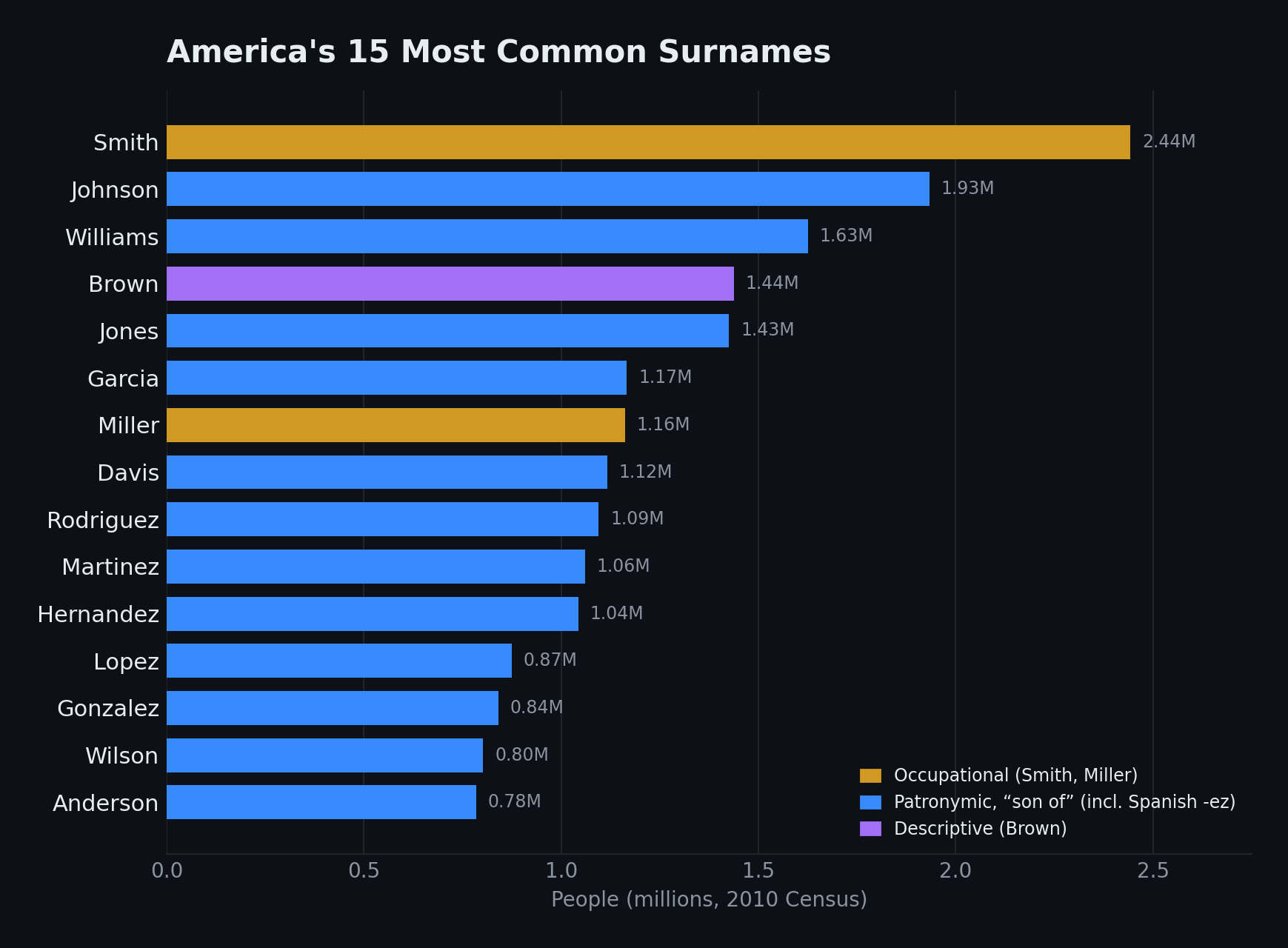
Jones is the fifth most common surname in the United States, which I notice more than most people because it is mine. About 1.4 million Americans share it. That feels like a crowd until you look at Vietnam, where close to 40% of the entire country goes by a single name: Nguyen.
The number of last names a country has, and which ones rise to the top, comes down to two things: how surnames were first handed out, and a slow math of inheritance that has been thinning the list ever since.
Where Last Names Came From
Most English surnames are younger than you would guess. For much of the early Middle Ages an English villager had only a first name. As populations grew and the crown needed to tax and track people, a second name got attached, and after a few generations it stuck and turned hereditary (Historic UK). Those names fall into a few buckets that still describe most of the list today:
- Occupational (what you did). Smith, a blacksmith, was the most common skilled trade in nearly every village, which is exactly why it is the most common surname in the English-speaking world. Miller, Taylor, and Baker come from the same place.
- Patronymic (whose child you were). Johnson is “John’s son.” Jones is the Welsh take on the same idea, and Williams, Davis, and Wilson follow the pattern. Spanish reaches the same place with a different ending: the -ez in Rodriguez, Martinez, and Gonzalez also means “son of,” so they are built exactly like Johnson.
- Locational (where you lived). Hill, Brooks, and Wood started as directions, as in “John by the brook.”
- Descriptive (what you looked like). Brown and Short began as plain nicknames.
Why America Has So Many
The American list is enormous. The 2010 Census counted about 6.3 million different surnames, and 62% of them appeared exactly once (American Name Society). Only 11 names were shared by more than a million people.
The very top barely moves. Smith, Johnson, Williams, Brown, and Jones have held the top five since the first census in 1790, even though the population has grown more than 80-fold since then (Census Bureau). What is changing is the tier just below. Garcia, Rodriguez, Martinez, and Hernandez have all climbed into the top 15, and by the 2020 count Rodriguez had reached the top 10. A young country fed by immigration keeps adding names faster than the old math can remove them.
Why Vietnam Runs on a Few
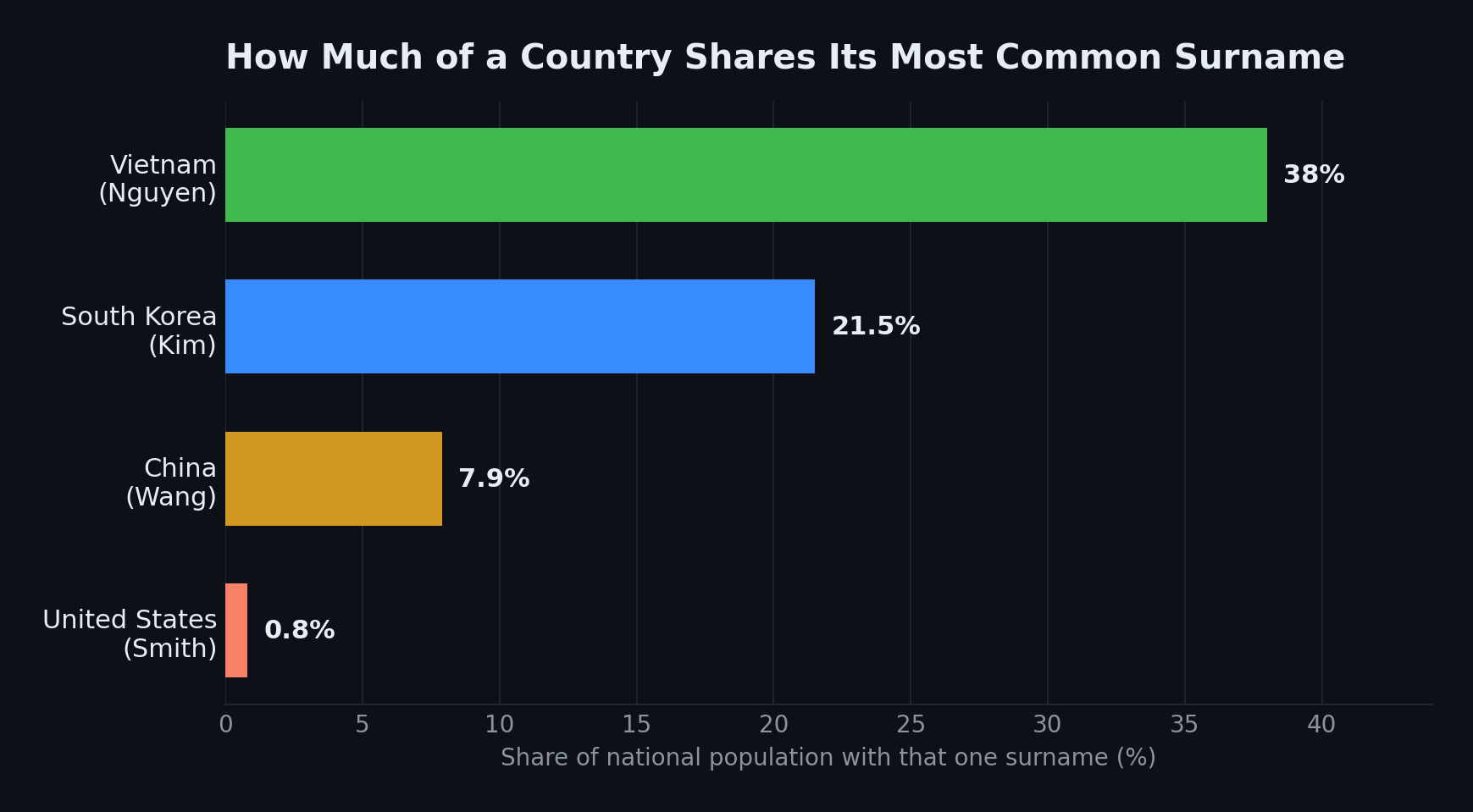
Vietnam is the opposite picture. By most estimates 30 to 40% of Vietnamese share the surname Nguyen, and the reason is political rather than occupational (Atlas Obscura). Vietnamese commoners often had no fixed surname for centuries. When a new dynasty took power, people frequently adopted, or were pushed to adopt, the ruling family’s name, both to show loyalty and to avoid being tied to the side that just lost. The Nguyễn dynasty was the last one standing, ruling into the 20th century, so its name had no successor to push it aside.
The same clustering shows up across East Asia for related reasons. Roughly 21% of South Koreans are named Kim (Korea Times), and China’s most common surname, Wang, covers close to 8% of more than a billion people (CGTN). These are old, continuous societies, and that turns out to matter.
The Math That Thins the List
Here is the part I found surprising. In the 1870s, Francis Galton noticed that aristocratic family names kept going extinct and wanted to know why. The answer, worked out with a clergyman named Henry Watson, is almost arithmetic: any male line that averages fewer than one son per generation will eventually disappear, and most lines hit stretches like that (Galton-Watson process).
Run that forward across a few thousand years and the pool of surnames keeps shrinking, with the survivors taking a larger and larger share. That is why a place with deep, unbroken lineages like China can hold more than a billion people on only a few thousand working surnames, while the United States, barely 250 years old and constantly importing new ones, has millions.
So a country’s most common last names carry more history than you would think. Look up where yours lands, and it probably tells you whether your ancestors were known for their trade, their father, their town, or just for outlasting everyone else.
Sources
- History of English Surnames (Historic UK)
- U.S. surnames in the 2010 Census (American Name Society)
- 2020 Census names data (U.S. Census Bureau)
- Why 40% of Vietnamese People Have the Same Last Name (Atlas Obscura)
- Kims make up 21% of the population (Korea Times)
- Wang remains the most common surname in China (CGTN)
- Galton-Watson process (Wikipedia)